Bellina Pink Cornflower
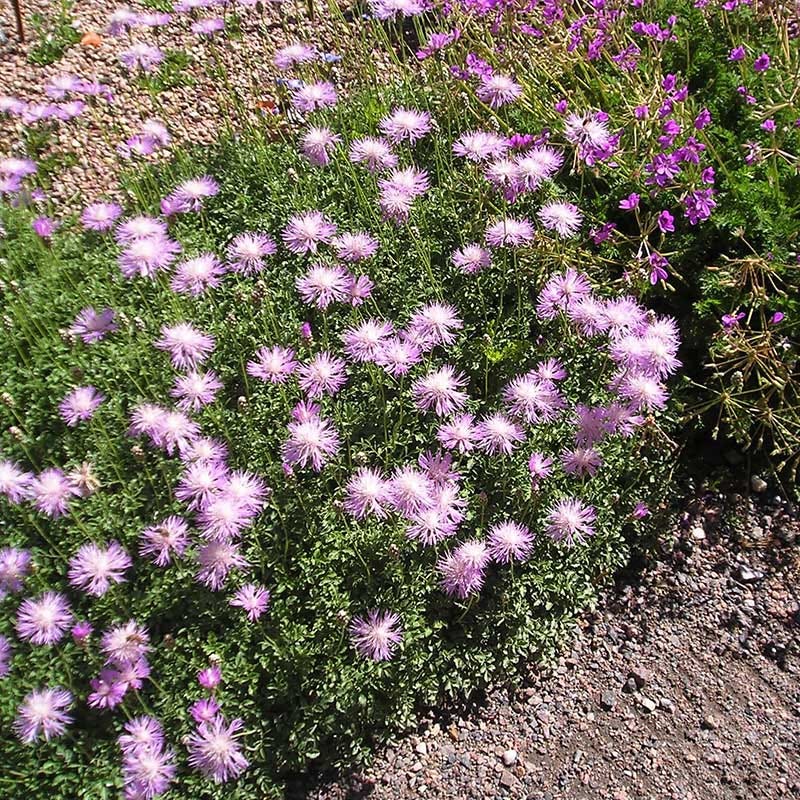
Originally from Turkey and the southern Caucasus mountains, Psephellus simplicicaulis or Centaurea simplicicaulis 'Bellina' (Pink Cornflower) has been grown by rock gardeners in the Intermountain West region for decades. Here, this well-behaved Cornflower relative remains a tidy, low growing mat. It was plucked out of the finest rock gardens of the Front Range, drawing interest with to its clean profile, handsome finely-textured foliage, and exuberant long-lasting blooms of frilly pink flowers.
Plant in dry gardens, where it mingles well with other mats and cushions, or in perennial garden borders, where its unusual textured buds contrast with more conventional plant material. ‘Bellina’ Pink Cornflower makes a great contrast for plants with tawny colors. Avoid deadheading to preserve its interesting seedheads and pair it with cool season grasses, like fescues (Festuca spp. and x.) for summer interest, or Undaunted® Ruby Muhly Grass (Muhlenbergia reverchonii UNDAUNTED®) for a three-season contrast in form and texture.
It has been tested by Plant Select®, a regional plant introduction organization founded in 1997 as a collaboration between Colorado State University and Denver Botanic Gardens. The organization has brought together many of the region's best horticulturists, plant breeders, landscapers, and commercial plant growers with the goal of introducing regionally suitable plants for the Great Plains and Intermountain states.
Originally from Turkey and the southern Caucasus mountains, Psephellus simplicicaulis or Centaurea simplicicaulis 'Bellina' (Pink Cornflower) has been grown by rock gardeners in the Intermountain West region for decades. Here, this well-behaved Cornflower relative remains a tidy, low growing mat. It was plucked out of the finest rock gardens of the Front Range, drawing interest with to its clean profile, handsome finely-textured foliage, and exuberant long-lasting blooms of frilly pink flowers.
Plant in dry gardens, where it mingles well with other mats and cushions, or in perennial garden borders, where its unusual textured buds contrast with more conventional plant material. ‘Bellina’ Pink Cornflower makes a great contrast for plants with tawny colors. Avoid deadheading to preserve its interesting seedheads and pair it with cool season grasses, like fescues (Festuca spp. and x.) for summer interest, or Undaunted® Ruby Muhly Grass (Muhlenbergia reverchonii UNDAUNTED®) for a three-season contrast in form and texture.
It has been tested by Plant Select®, a regional plant introduction organization founded in 1997 as a collaboration between Colorado State University and Denver Botanic Gardens. The organization has brought together many of the region's best horticulturists, plant breeders, landscapers, and commercial plant growers with the goal of introducing regionally suitable plants for the Great Plains and Intermountain states.
Original: $10.39
-65%$10.39
$3.64Description
Originally from Turkey and the southern Caucasus mountains, Psephellus simplicicaulis or Centaurea simplicicaulis 'Bellina' (Pink Cornflower) has been grown by rock gardeners in the Intermountain West region for decades. Here, this well-behaved Cornflower relative remains a tidy, low growing mat. It was plucked out of the finest rock gardens of the Front Range, drawing interest with to its clean profile, handsome finely-textured foliage, and exuberant long-lasting blooms of frilly pink flowers.
Plant in dry gardens, where it mingles well with other mats and cushions, or in perennial garden borders, where its unusual textured buds contrast with more conventional plant material. ‘Bellina’ Pink Cornflower makes a great contrast for plants with tawny colors. Avoid deadheading to preserve its interesting seedheads and pair it with cool season grasses, like fescues (Festuca spp. and x.) for summer interest, or Undaunted® Ruby Muhly Grass (Muhlenbergia reverchonii UNDAUNTED®) for a three-season contrast in form and texture.
It has been tested by Plant Select®, a regional plant introduction organization founded in 1997 as a collaboration between Colorado State University and Denver Botanic Gardens. The organization has brought together many of the region's best horticulturists, plant breeders, landscapers, and commercial plant growers with the goal of introducing regionally suitable plants for the Great Plains and Intermountain states.